Showing posts with label General Finance. Show all posts

Friday, September 23, 2011

Assured Returns

Don't be fooled by promises of guaranteed returns. It is critical to look for risks in an investment rather than seek assurances that are easy to give.

Investors love assurances. An assured return conjures up the image of a solid investment that will deliver on its promise. It seems like the best choice one can make with one's money. The truth is that delivering an assured return is the toughest act for an financial product. If investors think that assured return means a risk-free and safe investment, they should think again. The quality of the promise matters so much more than the promise itself.

Why is it tough to assure returns? The performance of an investment is primarily driven by the assets in which the investor's money is put to work. All assets are subject to risk. It is not possible to buy assets that will only appreciate in value. The degree of risk may vary, but no one can tell how an asset will perform in the future. Whether it is land, gold, houses, stocks or art, all assets are subject to the risk of price fluctuation. Prices are influenced by cyclical factors such as the state of the economy (the US housing prices crashed in 2008 triggering an economic recession), and structural factors that impact the specific asset. Some assets, such as property or equity, may face short-term risks that even out in the long-term, but they are risky anyway. All investment products are based on an underlying asset port-folio, which is risky by definition. Asking where, not how, the money will be invested is critical to understanding any assurance of return.

So, how do banks manage to assure returns on deposits? The answer lies in the balance sheet structure. A bank borrows from its depositors. Its assets are the loans it gives out to various borrowers using these deposits. The borrowers agree to pay a fixed rate of interest and return the principal, but their ability to keep the promise is again linked to their assets and performance. A person who has taken a home loan is likely to default, despite committing to a fixed rate of interest, if he loses his job or if his house drops in value significantly. Therefore, the bank's portfolio is also subject to risk. The bank does two things to keep its promise to depositors. First, it ensures that the loan portfolio is not completely risky and holds some safe investments in government bonds as well. Second, it does not fund all the loans with deposits, but ensures that a part of it is funded through equity investors who do not seek assurance. If the risk of the asset portfolio is borne adequately by equity capital, the bank is unlikely to default on its deposits. This is why capital adequacy is a regulatory requirement for banks that seek deposits from the public. This is also the reason that a bank with a poor quality loan portfolio or inadequate capital can default on it deposits despite assurance.

How does a company pay an assured return on its bonds? It does so by further extending the balance sheet structure used by a bank. Unlike a bank that holds loans, a company holds assets that are expected to generate future income. The risk associated with these assets can vary depending on the nature of the business. Therefore, a company has to be funded by its promoters even before it seeks any lenders. The lenders will, of course, want the company to have adequate equity capital already invested in it. They will ask an external credit rating agency to test the quality of assets that they are funding. As we know, these agencies can downgrade and change the rating unfavourably if a company is more likely to default.

How safe are government securities? The central government assures returns on its bonds and saving schemes because of its unique powers that provide it with three options to return the money it borrows. It can unilaterally increase the taxes, borrow internationally, or print money. We can, therefore, assume that the government will pay its liabilities. We know from the experiences in Europe that a government which borrows recklessly can also find itself in trouble, causing serious economic consequences for its lenders and citizens. Hence, the ability to assure returns comes either from the strength of the balance sheet in the case of a bank or company, and from special powers vested with a government. It is critical to learn how to look for risks in an investment, rather than seek assurances that are easy to give but tough to deliver.

Sunday, April 24, 2011

Insure your Big Day

If you are spending lakhs of rupees on your marriage, secure the event by opting for a suitable insurance package. Here are the things you should consider before picking one.


Given the wide expanse of wilting expense that are the hallmark of an Indian wedding, it's a marvel that most scrape through without major glitches or mishaps. A bigger wonder is that people don't feel the need to insure such high-cost events. If you are spending lakhs on a wedding, it would be prudent to protect yourself against vulnerabilities such as cancellation or damage during the ceremony.

Most companies sell wedding insurance as a part of event insurance. The policy broadly covers personal accident, postponement or cancellation of event, and damage to property at the venue. These policies can be customised as per one's needs. For instance, an ailing relative in the family, who might pose a risk of cancellation or postponement of event, can be covered. If you're phobic about the quality of food and see it as a risk, you can include food poisoning in the insurance. Terror attack is another threat that can now be covered.

Besides these, you can seek insurance against jewellery theft or cancellation in case the bride or groom in unable to make it to the event on time. If the event is cancelled or delayed due to damaged banquet/marriage halls, this too can be insured.

However, cancellation of an event due to dispute between the wedding parties is not available as a cover. There are exceptions, of course. If the groom does not turn up due to unpaid dowry and the ceremony is cancelled, you can be covered for the eventuality. Of course, the insurance company will not pick the tab if you off the wedding due to last-minute jitters. Willful negligence and criminal misconduct are also not covered.

It's important to read the fine print carefully as the terms and conditions vary among different insurance providers. It's equally significant to choose the cover that suits you rather than fall for the sales pitch. So, you can decide to buy insurance only for the main event spanning a day, or have the cover spread across several days and various ceremonies. Consider the various options offered by insurers and pick the one that fits your needs and budget. If a wedding is at your premises and your house is already covered against fire under the householder package, you don't need an extra cover. Also, if you already have jewellery insurance, knock it off from your wedding insurance policy.

When it comes to making a claim, remember that you need to have all the bills in place.Since wedding insurance is a non-standard product, the proofs required to claim vary. For instance, in case your house is robbed, only a copy of an FIR will be required. However, in case of theft of jewellery, you would also need bills along with the copy of an FIR.

Marriage in India is considered a sacred institution. Nobody likes to think that any thing will go wrong. The social milieu becomes a major obstacle while selling wedding insurance. It time to think differently at the time of big event.

Sunday, February 20, 2011

10 Commandments

10 Investing Thumb Rules

Back of the envelope calculations may not be accurate to the last decimal but they give you a fair idea of what you are looking for. Here are some immutable financial rules that can help you with quick estimates. Use them to get a grip on your finances and make informed investments decisions.

** These rules provide only a rough idea. The actual amount after compounding may vary.

Rule of 72:
This tells you in how much time will your money double. Divide 72 by the interest rate you are compounding your money with and you will arrive at the number of years it will take to double in value

Rule of 114:
Use this to estimate how long will it take to triple your money. It works the same way as the rule of 72. Divide 114 by the interest rate to know in how many years will Rs 10,000 become Rs 30,000.

Rule of 144:
Similarly, this tells you in how much time will your investment quadruple in value. For instance, if the interest rate is 12%, Rs 10,000 becomes Rs 40,000 in 12 years.

Rule of 70:
This is a useful rule for predicting your future buying power. Divide 70 by the current inflation rate to know how fast will the value of your investment get reduced to half its present value. This is especially useful for retirement planning, as it affects the way you set up your monthly withdrawals. However, do remember that the inflation rate varies from time to time.

The 10,5,3, Rule:
This is a neat little rule that states that you can expect returns of 10% from equities, 5% from bonds and 3% on liquid cash and cash-like accounts.

The Emergency Rule:
Put away at least 3-6 months worth of expenses in a liquid savings account to ensure it is available at short notice
-
4% withdrawal Rule:
How much should I withdraw during retirement? We often use the 4% rule to protect the principle and determine how much one can take from the retirement savings. If every month you withdraw Rs 50,000 you need a corpus of Rs 1 crore (Assuming that the corpus earns 9% and the inflation rate is 6%) to sustain monthly withdrawals for the next 25 years.

100 minus your age Rule:
This rule is used for asset allocation. Subtract your age from 100 to find how much of your portfolio should be allocated to equities.

Pay yourself first Rule:
Right from your first salary, put away a little for your retirement. Experts say 10% of your income should go into this. It is important to increase the amount as your income rises over the years. In every month you invest Rs 5,000 in a plan that grows 8.5% annually and increase your investment by 10% every year then after 30 years you will have Rs 2.5 crore.

Are you Wealthy ?
Do you consider yourself wealthy? A rule-of-thumb formula used by Thomas J Stanley & William D Danko  in The Millionaire Next Door, a book that studies selfmade American millionaires, can help determine if you are.

(Age x Pre-tax income) / 10 = Net worth

The logic behind the formula is that the older you are and the more money you make, the more net worth you should have. Dividing by 10 is the rule-of-thumb that fits American conditions. So, if you are a 35 year old living in the US with an annual income of $6,00,000 a year, your net worth should be $2.1 million [(35 x 6,00,000) / 10 = 21,00,000] for you to be considered wealthy. If you are 20 years old and you make $3,00,000 a year, you would be wealthy if your net worth was greater that $6,00,000.

Indian Context: Indian financial experts argue that a divisor that's closer to 20 would be more realistic in the Indian economy. According to them you should use a sliding scale linked to age. At age 40, someone earning Rs 7,50,000 a year should have a net worth of Rs15,00,000. For a 20 year old, the divisor should be 25. Hence a 20-year-old earning of Rs 3,00,000 a year should have net worth of Rs 2,40,000.

Saturday, February 12, 2011

Reverse Mortgage

In old age, let your home earn for you

Reverse mortgage allows you to cash in on one of your biggest assets -- house. So, if you need funds during retirement, pledge your property to a bank and you can secure periodic payments throughout your life.

Under this scheme, the bank assesses the value of the mortgage-free house and fixes a percentage of its current value based on parameters such as the likely lifespan of the senior citizen and his spouse. Typically the loan amount is 60-70% of the market value of the property. The applicants have the options of taking the loan principal as a lump sum at one go or as fixed monthly installments. After the death of the person concerned, the surviving spouse can continue to occupy the property till his/her demise while getting the same benefits.

From time to time, the value of the property is reassessed by the bank. If the valuation has increased, the borrowers are given the option of increasing the quantum of the loan. If they have opted for the monthly payment scheme, this amount is increased appropriately.

The principal and interest charges accrue in the bank while the applicants spend their lives in the home, or till they decide to sell the home, whichever is earlier. If the sale proceeds are lower than the accrued principal and interest amount, the bank takes the loss. This could happen if the real estate market has not moved up in the manner the bank has estimated.

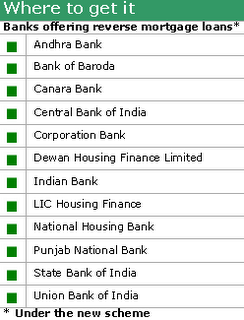
The rate of interest charged varies from bank to bank, but current rate ranges between9.5% and 11.5%. The borrower also has to bear some charges, such as those related to processing, valuation and legal proceedings, for availing of the loan. Despite the charges, the product has evolved and become more customer-friendly over time. The new scheme that was launched in 2010 is much more refined than the one introduced in 2007. Now, the insurance companies has also come into the picture and are offering better returns to the borrower.

The new reverse mortgage loan-enabled annuity (RMLeA) scheme has lots of advantages compared with the earlier product, which was marred by limitations such as low payments and a cap of 20 years.Under the new scheme, the borrower is entitled to a higher loan based on the higher percentage assigned to the value of the property. Also, the principal amount of loan remains intact and is available for repayment to the bank on the demise of the borrower. So the borrower's heirs only have the liability of paying the interest accrual.

Still the concept has not taken off in India in a big way unlike in western countries., where the product is popular. Indian are sentimentally attached to their homes. Here, a parent would prefer to pass on his house to his children, unlike in the West, where a child would rather start living on his won before he turns 18.

This concept is primarily for senior citizens. Unless someone explains it lucidly to them, they are unlikely to understand it. Often, the children don't explain or simplify the concept because they fear that they may be adversely affected if the house is repossessed by the bank after the death of their parents.


Wednesday, February 2, 2011

7 Faces of Profit

Its the time of the year when quarterly reports flood mailboxes and dailies, and the words 'earnings' and 'profit' jump out from all over. But which profit should you consider to evaluate a company ? What is the utility of profitability measures ? Here's a guide to understanding profits.

1. Gross Profit
It is the amount earned from sale of products after deducting production costs.
What it does:
Signals efficiency with which a company is making money. Indicates how much mark-up a company can generate on its sales. A company with rising gross profit means it can command premium prices, cost efficiency, and makes the company highly competitive.
Black spots:
Works as a primary indicator. G.P. is similar to an incomplete story. To know more about the company, you have to read other signs.

2. Ebitda
It means earnings(or profit) before interest, taxes, depreciation and amortization. Calculated by subtracting operating, general, administrative and marketing expenses from gross profit.
What it does:
Measures profitability. Say, you are having trouble deciding between companies, it is the best tool to compare them because it weeds out the effects of financing and accounting decisions.
Black spots:
It is not a good measure of cash flows. Companies may use it to dress up earnings.

3. Ebit
It is the earnings before interest and taxes. Calculated by deducting depreciation and amortization charges from Ebitda.
What it does:
Measures a company's earning capacity. Examines performance of companies by negating the effects of financing and taxes. Useful for shareholders and creditors.
Black spots:
Ignores unavoidable cash outflows due to interest and taxes.

4. EBT
It is the earnings (or profit) before taxes and is calculated by deducting interest expenses from Ebit.
What it does:
Compares companies in different tax jurisdictions. Useful for comparing companies within a sector. Shows how well a company is using its borrowings to enhance its return on equity.
Black spots:
Again, doesn't give a wholesome picture. Discounting the tax effect is unwise.

5. EAT
This is the Net Profit. Earnings after tax, or net profit, is the most common way to calculate a company's profit. EAT is the company's profit after deducting manufacturing and operating expenses, depreciation, interest and tax.
What is does:
Tells the story of a company's performance over a period. Handy tool for equity shareholders as it is the money left after a company makes all payments. EAT helps shareholders analyse the earnings of a company on a per-share basis. Equity dividends are also based on EAT.

6. EPS
Earnings per share is calculated by dividing net profit by the total number of shares.
What is does:
Considered the single-most important measure of a share's price. Shows how much a company is earning on every share. For example, if a company makes a post-tax profit of 12 lakh INR and there are 2 lakh shares in issue, the EPS would be 6 INR.
Black spots:
Ignores capital. Two companies can have the same EPS, but the second company may have used lesser capital employed. Other things being equal, the second is the better company as it is more efficient.

7. P/E Ratio
P/E = Current share price of a company divided by its earnings per share.Though not strictly a measure of profit, it is a favourite tool of analysts to measure a company's value. It tells if a share is overvalued or undervalued.
What it does:
Shows how much an investor is willing to pay for every rupee of a company's earnings. Analyst use a forward P/E ratio to fix target prices of companies. Generally, a high P/E means investors expect higher earnings growth in the future.

Black spots:
The PE, at best, a lagging indicator, which takes into account only the past earnings, not the future growth. As such, a low PE may give the impression that the stock is undervalued, but if the company's earnings are not growing, its value is also not likely to rise. Similarly, a high PE could make a stock's valuation seem stretched, but what if the company's earnings are likely to keep growing rapidly? In such cases, using the PE ratio would not be a good idea. 

8. PEG
Price to Earning Growth metric. It is essentially an enhanced version of the PE ratio, which combines value with growth. the PEG ratio is calculated by dividing the stock's PE ratio by its expected 12-month earnings growth rate. (PEG ratio = PE / earnings per share growth). 
What it does:
The premise for using this ratio is rooted in the understanding that the growth rate of a stock that is valued correctly would be almost equal to its PE ratio. In other words, The PEG ratio of a fairly valued stock would ideally be equal to one. When the PEG is equal to one, it means that the market has correctly factored in the expected earnings growth. A PEG ratio of less than one would mean that the market has not adequately priced in higher growth expectations and that the stock is, therefore, undervalued. A PEG ratio higher than one implies that the market is paying much more for the stock than is justified by its earnings growth. So, the lower the PEG of a stock, the better it is.
Black spots:
Its not foolproof indicator of value. Since it is a forward looking measure, one has to rely on analyst's projection of future earnings, which may not always be accurate.